

Lessons
Free
Group Project
Related Courses
Free

Free
Free

Free

Department of Political Science
Concordia University
Fall 2017
Professor: Erik Chevrier
Office Hours: By Request
Professor’s Office: H-1125.12
Class Time: Wednesday 1:15 – 4:00PM
E-mail: professor@erikchevrier.ca
Classroom – MB 5.275
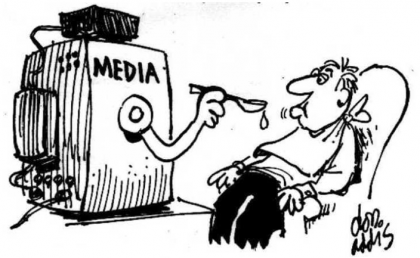
Politics and media studies are interrelated and multifaceted topics. Newspapers, radio, TV, and the internet are some of many media forms that carry messages about political ideas, social relations and prevailing power structures. Signs and symbols can be creative and/or coercive. They can be used to educate people about world issues so that people can participate in political platforms as informed citizens; however they can also be used to misinform the public in order to manage public opinion and push a specific political agenda. A variety of political actors, such as political parties, pressure groups, people with wealth and influence, and concerned citizens everywhere use media to their advantage – some with more, others with less success.
Changes in technology have revolutionized the social, economic and political landscape. Global communication has been facilitated by the proliferation of portable communication devices and social media platforms. Internet sites, like Facebook and Twitter have allowed people to become amateur journalists and political commentators. In 2014, in Ferguson, Missouri, protesters themselves broadcast the demonstrations against police brutality allowing the world to witness their uprising; recently in Syria, civilians have been live-streaming the aftermath of the bombing campaigns and gas attacks; even the president of the U.S.A Donald Trump, has been informing citizens about policy reforms and executive orders via Twitter.
In this course, we will examine the interaction between politics and media by looking at how technological changes in communication has shaped political life. We will use a multidimensional framework considering the complex relationship between media producers, spectators, messages and technologies as well as the political and socio-economic environment from which media is produced and received.
In this course, we will address questions like: What is the key to effective media management? Who controls what gets onto the media and what gets excluded? What makes something newsworthy? Why are some issues covered and many others ignored? How does the media shape our political culture, our minds and identities as a people? What can we do to ensure, that this instrument that plays such a powerful role in the formation of our political consciousness, remains fair, and factual? How can we ensure that the media does not fall into the hands of those who are driven by selfish or vested interests?
By the end of this course, students will:
Course Materials and Text:
Students are expected to complete ALL the designated readings and watch ALL of the assigned videos BEFORE EACH CLASS. Students are also expected to attend ALL classes, and participate in class discussions.
The required readings for this course is contained in a course-pack available at the library bookstore. Please see the course schedule below for the dates the readings are due.
The power-point lecture notes will be posted on the course site on a weekly basis before each class.
Students are required to watch at least two of the following documentary movies:
The Century of the Self (2002) – Adam Curtis
The Persuaders (2003) – Barak Goodman and Rachel Dretzin
Manufacturing Consent (1992) – Mark Achbar and Peter Wintonick
Control Room (2004) – Jehane Noujaim
Operation Hollywood (2004) – Emilio Pacull
This Film is Not Yet Rated (2006) – Kirby Dick
We are Legion: The Story of Hacktivists (2012) – Brian Knappenberger
Recommended readings: URLs and other electronic sources may be posted on the course website from time to time. Please visit the course website to get this material. These are only for interest and are not required.
Course Format
This course will consist of a variety of pedagogical styles including lectures, discussions, guest speakers, and community service learning. Students are expected to read the required text and/or watch the assigned movie before coming to class. In class, students will engage with each other through interactive activities, discussions and by talking with invited media professionals and political actors.
Course Evaluation
Exam 1 30%
Exam 2 30%
Short Paper 20%
Group Project 15%
Class Participation 5%
Letter Grade Equivalency
Your numerical grades will be converted to letter grades as follows:
A+ (93 – 100%) B+ (77 – 79%) C+ (67 – 69%) D+ (57– 59%)
A (85 – 92%) B (73 – 76%) C (63 – 66%) D (53 – 56%)
A- (80 – 84%) B- (70 – 72%) C- (60 – 62%) D- (50 – 52%)
F < 50%
Lecture Schedule: Themes and Required Readings
This is a TENTATIVE schedule and is subject to change. Be sure to consult the course website regularly to be aware of any changes.
Course schedule, Topics and Required readings:
September 6 Introduction
Nesbitt-Larking, P. (2009) Politics, Society and the Media (2nd Edition), Broadview Press. (Pages 15, 16 and 17)
September 13 History of the Canadian Mass Media
Nesbitt-Larking, P. (2009) Politics, Society and the Media (2nd Edition), Broadview Press. (Chapter 2 and 3)
September 20 Time, Space, Culture, Nation
Robinson, D. (2009) Communication History in Canada, Oxford University Press. (Section 2)
September 27 Media in the Political, Socio-Economic Environment
Nesbitt-Larking, P. (2009) Politics, Society and the Media (2nd Edition), Broadview Press. (Chapter 4)
Taras, D. (2015) Digital Mosaic; Media, Power and Identity in Canada, University of Toronto Press, (Chapter 1)
October 4 Political Economy of the Media in Canada
Nesbitt-Larking, P. (2009) Politics, Society and the Media (2nd Edition), Broadview Press. (Chapter 5)
Winseck, D. (2016) Media Ownership in Canada. In Who Owns the World’s Media, Oxford University Press. (Chapter 17)
October 11 State and Political Regulating of the Media
Nesbitt-Larking, P. (2009) Politics, Society and the Media (2nd Edition), Broadview Press. (Chapter 6)
October 18 Mid-Term Exam
October 25 Group Project – Short Paper Due
November 1 Media Organizations
Nesbitt-Larking, P. (2009) Politics, Society and the Media (2nd Edition), Broadview Press. (Chapter 7 & 13)
November 8 Construction and Deconstruction of Texts
Nesbitt-Larking, P. (2009) Politics, Society and the Media (2nd Edition), Broadview Press. (Chapter 10)
Riffe, D., Lacy, S., Fico, F. (2014) Analyzing Media Messages; Using Quantitative Content Analysis in Research, 3rd edition, Routledge. (Chapter 1 and 2)
November 15 Media Effects – Politics of Reading
Danesi, M. (2010) Semiotics of Media and Culture. In Cobley, P., The Routledge Companion to Semiotics, Routledge. (Chapter 9)
Nesbitt-Larking, P. (2009) Politics, Society and the Media (2nd Edition), Broadview Press. (Chapter 9 & 11)
Taras, D. (2015) Digital Mosaic; Media, Power and Identity in Canada, University of Toronto Press, (Chapter 4)
November 22 Media, Technology and Privacy
Dwyer, T., (2016), Convergent Media and Privacy, Palgrave MacMillan. (Chapter 5)
Goggin, G. (2012), New Technologies and the Media, Palgrave MacMillan. (Chapter 2)
Taras, D. (2015) Digital Mosaic; Media, Power and Identity in Canada, University of Toronto Press, (Chapter 5)
November 29 Group Presentations
Classroom Conduct:
The governing principle of classroom conduct is mutual respect. Oppressive statements will not be tolerated in any form. This includes but is not limited to racism, sexism, classism, homophobia, transphobia, hate speech, bullying, and/or forms of derogatory statements. It is important that when others (including the professor) speak, we listen quietly and do nothing to hinder the attentiveness of anyone around us. If anyone is perceived to be hindering the ability of others to be attentive, they will be warned by the instructor. If the behavior continues, they will be asked to leave the room.
Late assignment policy:
Unless you are given permission in advance, late assignments will not be accepted without adequate documentation of medical or personal emergencies.
Handing in Assignments:
All assignments MUST be submitted in hard copy at the beginning of class on the due date. Any assignment submitted electronically will be subject to a reduction of 10% of the value of the assignment.
Academic Honesty:
Academic dishonesty is a serious offense and will not be tolerated. Acts of dishonesty include, but are not limited to, plagiarism. It is your responsibility to know and understand university and departmental policies. All acts of academic dishonesty will be reported. Please refer to the Undergraduate Calendar for complete details of offenses and penalties: http://registrar.concordia.ca/calendar/17/17.10.html
Students with Disabilities:
Students with disabilities should register with the Office for Students with Disabilities and follow its procedures for obtaining assistance. In addition, please inform me of any special needs you have so that I can make appropriate accommodations. Please visit this website for more information. http://www.concordia.ca/students/accessibility.html